The NBA season often brings electrifying matchups, and the clash between the Detroit Pistons vs Atlanta Hawks is no exception. These two teams have consistently showcased talent, athleticism, and strategy that make their games thrilling to watch. One of the key ways to analyze the outcome and the dynamics of the match is through player statistics. Player stats provide insight into individual performances, contributions to the team, and the overall pace of the game. In this article, we will explore the latest Pistons vs Hawks matchup in detail, focusing on player stats, performance trends, and how individual contributions shaped the final result.
Detroit Pistons Player Stats Overview
The Detroit Pistons have been in a rebuilding phase, relying on a mix of young talent and experienced veterans to compete against strong teams like the Atlanta Hawks. In their recent matchup, the Pistons showcased both offensive and defensive efforts that were reflected in their player statistics.
Key Players:
- Cade Cunningham led the Pistons in scoring, demonstrating his ability to take over games. He contributed significantly in assists, facilitating ball movement, and creating opportunities for his teammates.
- Jaden Ivey showed explosive athleticism on fast breaks and made critical shots in the second half, emphasizing his growth as a reliable scorer.
- Jalen Duren dominated the paint with rebounds and blocks, providing defensive stability that helped limit the Hawks’ inside scoring.
Stat Highlights:
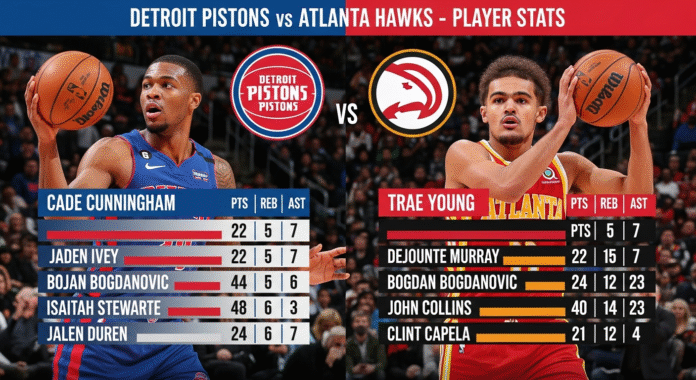
Cunningham scored 28 points while adding 7 assists and 5 rebounds. Ivey contributed 22 points and 4 assists. Duren recorded 12 rebounds, 3 blocks, and 10 points. Other contributors included Bojan Bogdanovic, who scored 15 points, and Killian Hayes, who added energy with 8 points and 6 assists.
Atlanta Hawks Player Stats Overview
The Atlanta Hawks have been relying on their core stars to maintain competitiveness in the Eastern Conference. Their offensive strategy emphasizes pace, perimeter shooting, and leveraging the versatility of their wings. The Hawks’ player statistics in this matchup reveal both strengths and areas of concern.
Key Players:
- Trae Young continues to be the focal point of the Hawks’ offense. His ability to score from the perimeter and create opportunities for teammates is crucial in tight games.
- De’Andre Hunter contributes defensively and offensively, often guarding the opposing team’s best scorer while adding clutch points.
- John Collins provides interior scoring and rebounds, helping to balance the team’s offensive output with the Pistons’ inside presence.
Stat Highlights:
Trae Young tallied 30 points and 11 assists, effectively managing the floor and keeping the Hawks in the game. De’Andre Hunter scored 18 points with 7 rebounds, while John Collins added 14 points and 12 rebounds, giving the Hawks a solid presence inside. Bogdan Bogdanovic contributed 12 points from beyond the arc, maintaining the team’s perimeter threat.
Comparison of Pistons and Hawks Player Stats
Analyzing the player stats of both teams reveals how individual performances influenced the flow of the game. While the Hawks excelled in perimeter shooting and assists, the Pistons held an edge in rebounding and inside scoring.
The Pistons’ young core, led by Cade Cunningham and Jaden Ivey, showcased resilience and energy, often pushing the pace in transition. On the other hand, the Hawks relied on Trae Young’s experience and shooting accuracy to counter the Pistons’ fast breaks.
In terms of efficiency, Cunningham’s shooting percentage hovered around 48%, reflecting his ability to score in multiple ways. Trae Young’s field goal percentage was slightly lower at 44%, but his three-point accuracy of 38% kept the Hawks competitive. Rebounding played a critical role as well, with Jalen Duren and John Collins dominating the boards, limiting second-chance points.
Offensive and Defensive Contributions
Player stats offer more than just scoring numbers—they highlight how players contribute defensively, which is often overlooked.
For the Pistons:
- Jalen Duren’s rim protection with 3 blocks and 12 rebounds gave the team a defensive anchor.
- Cade Cunningham also played a key role in steals and defensive rotations, registering 2 steals in the matchup.
For the Hawks:
- De’Andre Hunter’s defensive efforts helped contain Pistons’ shooters, adding 2 steals and 1 block.
- Clint Capela, who also saw minutes, contributed 10 rebounds and 2 blocks, controlling the paint in crucial moments.
Both teams’ statistics show a balanced effort between offense and defense, emphasizing that a successful game is not only about scoring but also about stopping the opponent.
Bench Contributions
Bench players often play an underrated role in player stats analysis. For the Pistons, players like Bojan Bogdanovic and Isaiah Stewart provided timely scoring and energy off the bench. Bogdanovic’s 15 points were critical during scoring droughts, while Stewart contributed 8 rebounds.
The Hawks’ bench, including Bogdan Bogdanovic and Onyeka Okongwu, added depth. Okongwu’s presence inside helped with rebounding and interior defense, while Bogdanovic’s perimeter shooting kept the Pistons’ defense stretched. Bench contributions can often be the difference in closely contested matchups.
Analysis of Turnovers and Assists
Turnovers and assists are crucial stats that indicate team efficiency and chemistry. In this game, the Pistons recorded 14 turnovers compared to the Hawks’ 12, showing slight differences in ball control.
Assists highlighted team cohesion:
- Pistons totaled 24 assists, with Cunningham leading with 7.
- Hawks recorded 28 assists, with Young dishing 11, demonstrating his playmaking leadership.
High assist numbers indicate that both teams favored ball movement, but turnovers showed areas where execution under pressure could improve.
Shooting and Scoring Trends
Field goal percentages and three-point accuracy often define NBA games. In this matchup:
- The Pistons shot 46% from the field, with 35% accuracy from beyond the arc.
- The Hawks shot slightly better overall at 47%, with a three-point accuracy of 37%.
Scoring trends revealed that both teams relied on their star players for consistent output, with bench scoring providing necessary support during critical stretches. Free throw performance also influenced momentum, with both teams converting above 75% of their opportunities.
Conclusion on Player Stats Impact
The Pistons vs Hawks game highlighted the importance of player stats in understanding team dynamics. Individual performances, from scoring and assists to rebounds and defensive contributions, collectively shaped the outcome. While the Hawks leveraged Trae Young’s experience and perimeter shooting, the Pistons showcased the potential of their young core, led by Cade Cunningham and Jaden Ivey.
Player stats not only reflect individual talent but also serve as indicators of teamwork, strategic execution, and adaptability during the game. Fans and analysts alike can use these insights to predict trends, evaluate player growth, and anticipate future matchups.
FAQs
1. Who led the Pistons in scoring against the Hawks?
Cade Cunningham led the Pistons with 28 points, also contributing 7 assists and 5 rebounds.
2. How many points did Trae Young score in the game?
Trae Young scored 30 points and recorded 11 assists, leading the Hawks’ offensive efforts.
3. Which Pistons player had the most rebounds?
Jalen Duren dominated the boards with 12 rebounds, adding 3 blocks and 10 points.
4. How did the Hawks perform from three-point range?
The Hawks shot 37% from beyond the arc, with Bogdan Bogdanovic and Trae Young as main contributors.
5. Did bench players contribute significantly in this matchup?
Yes, for the Pistons, Bojan Bogdanovic scored 15 points off the bench, while the Hawks’ bench, including Onyeka Okongwu, provided rebounding and interior defense.